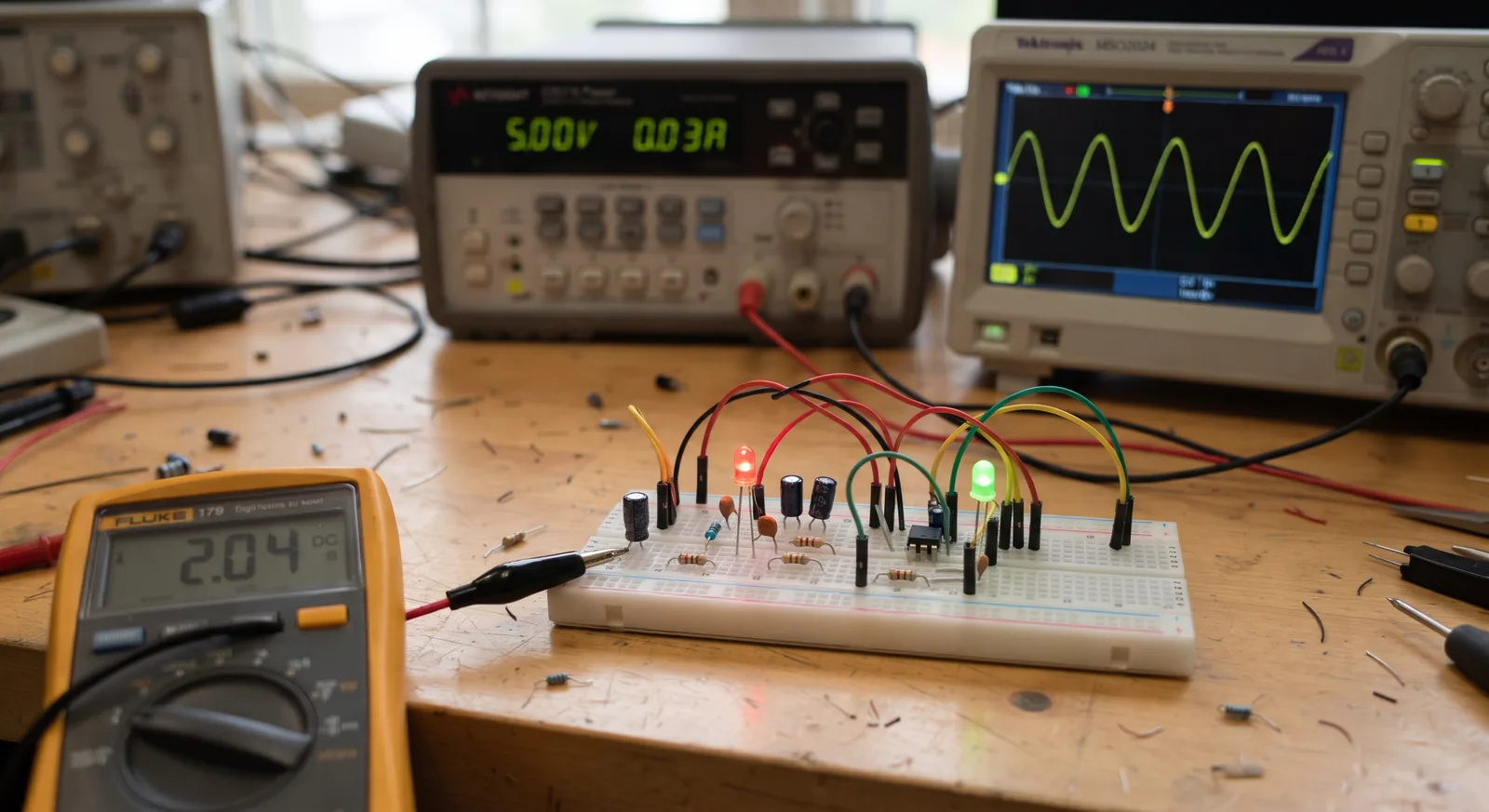
Electronics Fundamentals and Circuit Design
Voltage, current, components and breadboard circuits, measured with a multimeter and oscilloscope.
Courses in this pathway
Course
FREEElectronics Fundamentals and Circuit Design
Learn electronics from the ground up and build circuits that work: voltage, current and Ohm's law, power and safety, reading schematics, the multimeter and bench supply, series and parallel circuits, dividers and Kirchhoff's laws, diodes and LEDs, capacitors, inductors and relays, transistors as switches, op-amps, digital logic, the oscilloscope, power supplies and regulators, breadboarding, soldering and troubleshooting, and reading datasheets. Calculation labs, two build projects and a graded capstone.
Course
PROElectronics in Practice: The Arithmetic Behind Real Circuits
Learn the numbers that decide whether a circuit works, with Python on invented bench jobs in your browser. Decode resistor colour bands with their tolerance, size an LED resistor from the E12 series with the real current and heat, see how a load drags a voltage divider down, reduce a series-parallel network to every current, time RC circuits and a 555 blinker, convert ADC counts to volts and degrees, budget a battery with a linear and a switching regulator, set timer prescalers, PWM and servo pulses, and review a board against derating rules. The parts are generated for you alone, and the functions you write are also tested on hidden data with the edges that real boards find first.