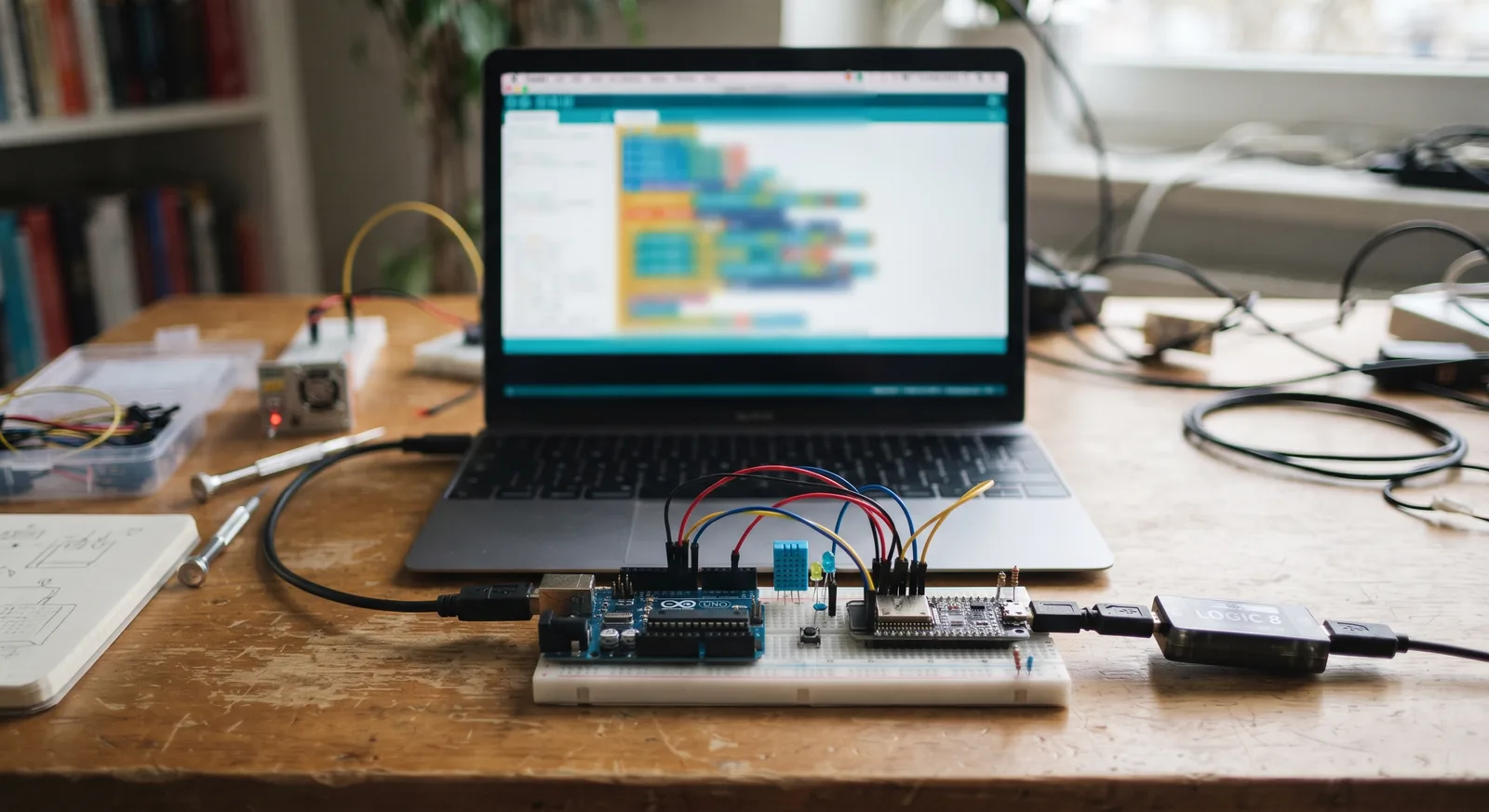
Microcontrollers and Embedded Programming
Programming Arduino and ESP32 boards: inputs, outputs, timing and debugging.
Courses in this pathway
Course
PROMicrocontrollers and Embedded Programming
Program the small computers inside real products: what a microcontroller is and how to choose one, the toolchain, C and C++ for embedded code, digital and analog input and output, PWM, serial communication, non-blocking timing, interrupts and timers, I2C and SPI, sensors and displays, low-power design, reliability with the watchdog, and firmware structure with git. Arduino-style C++ on the Uno and ESP32, with calculation labs, command labs, two build projects and a graded capstone.
Course
PROFirmware in Practice: The Small Rules That Decide Whether Embedded Code Works
Learn the rules behind microcontroller code that works for years, with Python on invented bench jobs in your browser. Set, clear and toggle register bits, debounce a switch, run tasks across the 49-day millisecond wrap, compute UART dividers and baud rate errors, parse serial commands with a checksum, decode I2C frames and a two's complement sensor, decode a quadrature encoder with missed counts, simulate a ring buffer with two overflow policies, and review a reset log for boot loops, brownouts and watchdog resets. The data is generated for you alone, and the functions you write are also tested on hidden data with the edges that real devices find first.