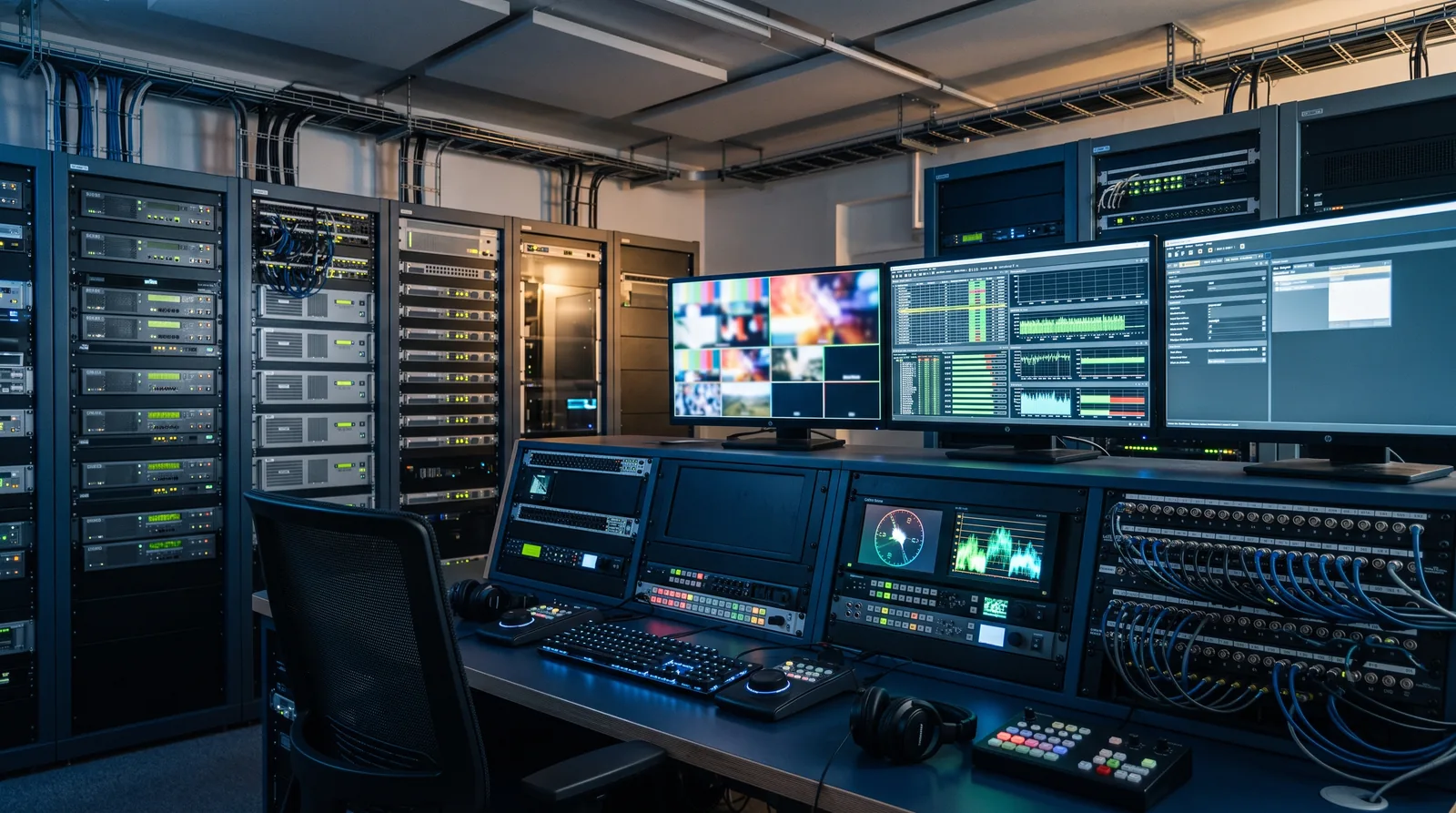
Television Streaming and DVB Engineering
Video transport, transport-stream analysis and DVB troubleshooting.
Courses in this pathway
Course
PROTelevision Streaming and DVB Engineering
Learn television delivery from the picture up: how television reaches viewers, video fundamentals and raw data rates, H.264, HEVC and AV1 codecs and GOPs, television audio, loudness and lip-sync, the MPEG transport stream with PIDs and PSI, PES timestamps and the PCR, DVB service information and the programme guide, DVB-S and DVB-S2 satellite, satellite link budgets, DVB-T, DVB-T2 and DVB-C, IP delivery with RTP, multicast and SRT, adaptive streaming with HLS and DASH, headend multiplexing and statistical multiplexing, measurement and TR 101 290 monitoring, conditional access and DRM, and running a television platform. Includes command labs, two build projects and a graded capstone.
Course
PROTelevision in Practice: The Arithmetic That Keeps a Channel on Screen
Learn the arithmetic behind a television channel that stays on screen, with Python on invented headend jobs in your browser. Work out bits per pixel and storage for every channel, check the continuity counters of a transport stream, check the PCR clock for jitter and drift, plan a satellite multiplex against its transponder, calculate a satellite link budget with rain margin, size a multicast link with IP headers and FEC, simulate the adaptive bitrate choices of a player, audit the now and next guide for gaps and overlaps, and write a TR 101 290 health check that must say ok on a clean multiplex. The data is generated for you alone, and the functions you write are also tested on hidden data with the edges that real headends find first.